
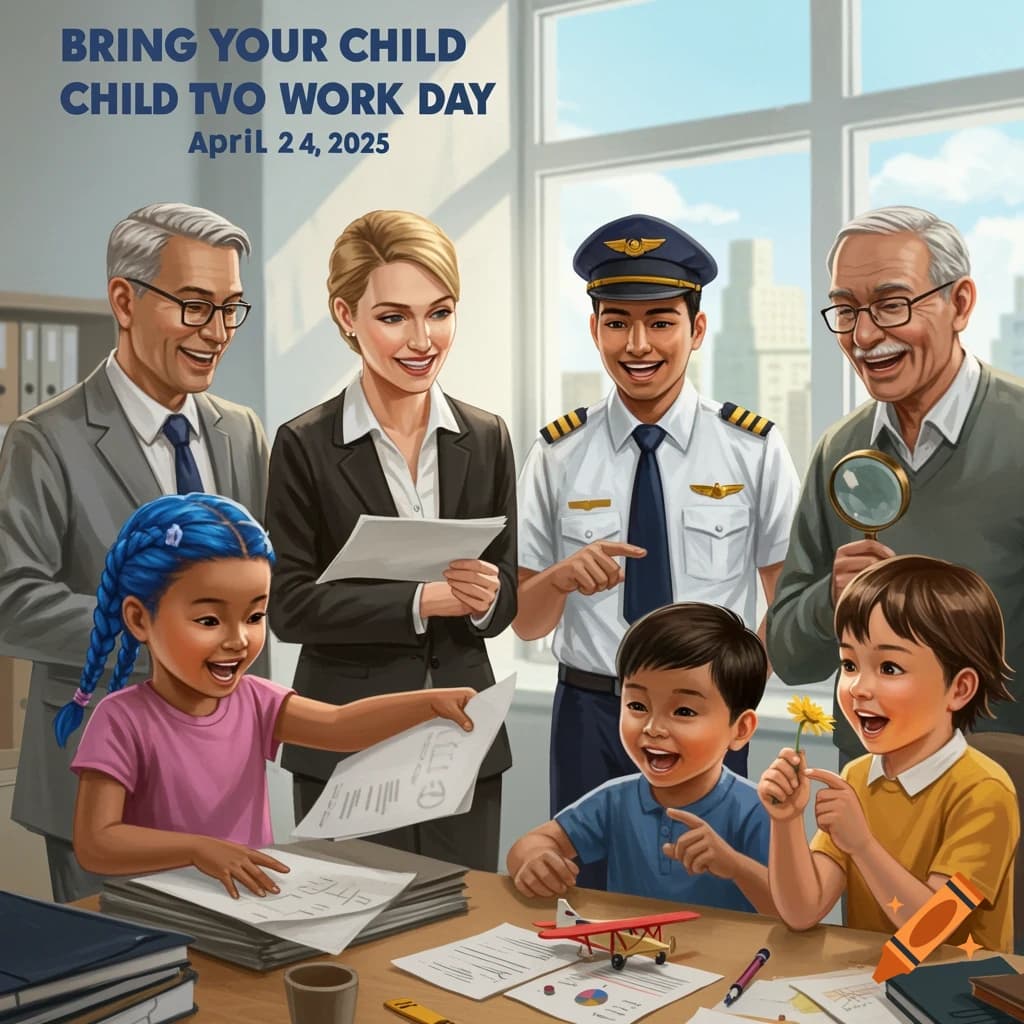
You know when a child walks into your office, looks around at your monitor, your spreadsheets, your ergonomic keyboard that took three weeks to justify expensing - and just goes "this is it?"
That is Bring a Kid to Work Day in one sentence. Every year on the fourth Thursday of April, workplaces across the country throw open their doors and let the under-twelve crowd experience the full, glorious mundanity of adult professional life. This year it falls on 23 April 2026. And honestly? The kids are going to be devastated.
What Bring a Kid to Work Day Actually Involves
 Image: craiyon.com
Bring a kid to work and you will spend roughly forty minutes explaining what you do before realising you can't quite explain it yourself.
The day started with genuinely good intentions. Launched in 1993 by the Ms. Foundation for Women as "Take Our Daughters to Work Day," it was designed to show girls that careers beyond traditional gender roles were possible and available to them. In 2003, it expanded to include boys and was rebranded as "Take Our Daughters and Sons to Work Day." The federal government - including the U.S. Department of the Interior - runs it as an official programme. So yes, this is a real thing with real institutional backing.
The myth is that kids find it inspiring. The reality is that they find it baffling. Your child will watch you answer emails for eleven minutes, attend a calendar invite called "Sync - 30 min," and consume a sad desk lunch. They will ask why you have to ask permission to go to the toilet. You will not have a good answer.
The Part Where Everyone Has a Tiny Existential Crisis
The kids aren't the only ones recalibrating.
There's something quietly destabilising about seeing your entire professional existence through the eyes of someone who still considers "colouring in" a viable afternoon activity. You start noticing things. The fact that your office has no windows. The fact that Dave from finance has been saying "circling back" in every meeting since 2019. The fact that the snack corner has exactly one granola bar left and everyone is pretending they don't see it.
Your kid sees all of this with fresh, judgemental eyes.
They will ask why the printer is broken if it's always broken. They will sit in on a stand-up meeting and quietly inform you that no one in that room seemed to know what was happening. They will draw a picture of your desk setup and label it "boring." You will frame it.
What the Kids Actually Learn (And What We Learn From Them)
The programme isn't just photo opportunities and miniature visitor badges. Done well, it genuinely works.
Young people who attend structured workplace visits develop earlier, more realistic expectations about careers. They ask better questions. They start connecting school subjects - maths, writing, science - to actual jobs. The Department of the Interior, along with dozens of other federal agencies, runs activities specifically designed to be educational rather than just a show-and-tell.
But here's the ripple effect no one talks about: parents come home different. Slightly more self-aware. Having been forced to explain their job in terms a child could understand, many of them realise their job is either more interesting than they give it credit for - or significantly less defensible than they thought.
Both outcomes are valuable.
The workplaces that do this well treat it as a genuine investment. The ones that don't hand kids a colouring sheet and park them next to the printer for six hours. You can tell which camp your office falls into by whether anyone under eighteen looks like they're having a good time by 11am.
Back to That Look on Their Face
So your kid scans the open-plan office one more time. The motivational poster. The dying succulent. The whiteboard that still says "Q3 GOALS" from three quarters ago.
And then something shifts. Maybe it's the moment they get to sit in your chair and spin around. Maybe it's when someone explains what a budget actually is and their eyes go wide. Maybe it's just the novelty of being somewhere they're not usually allowed.
They're not inspired yet. But they're watching. And something is landing.
Bring a kid to work and you might not change their life that day. But you might plant one small, stubborn seed of "I could do something, someday, somewhere." Even if the somewhere currently smells like stale coffee and has a broken printer.
That's the whole point, really.
Frequently Asked Questions
Q: When is Bring a Kid to Work Day 2026? A: Bring a Kid to Work Day 2026 falls on Thursday, 23 April. It is observed annually on the fourth Thursday of April.
Q: What age is appropriate for Bring a Kid to Work Day? A: Most workplaces that participate recommend children aged 8 to 18. Younger children may struggle to stay engaged with a full workday, while older teens often find the experience more directly relevant to their own career thinking.
Q: Who started Take Our Daughters and Sons to Work Day? A: The Ms. Foundation for Women launched the programme in 1993 as "Take Our Daughters to Work Day." It expanded to include boys in 2003 and was renamed to reflect that change.
Q: Do federal government offices participate in Bring a Kid to Work Day? A: Yes. Federal agencies including the U.S. Department of the Interior run official programmes for the day, often with structured activities designed to educate young visitors about government careers and public service.
Q: What should I actually do with my kid at work that day? A: Beyond showing them your desk, involve them in age-appropriate tasks - a simple project, a tour of different departments, or a Q&A with colleagues in different roles. The more variety, the better - no child should spend four hours watching someone update a spreadsheet.
This article was researched and written with AI assistance, then reviewed for accuracy and quality. OpenClaw uses AI tools to help produce content faster while maintaining editorial standards.