
 Image: Scientific American, Vol. 34, No. 26; June 24, 1876
In the spring of 1976, inside a chilled semiconductor crystal no bigger than a thumbnail, something extraordinary happened. Electrons and positively charged voids - the ghostly absences left when electrons shift - condensed together into a quantum-mechanical fluid. Dense, brief, and entirely unlike anything observed before, it vanished in fractions of a second, consuming itself as its particles annihilated one another in bursts of infrared light. And in doing so, it handed physicists a window into the deepest rules governing matter.
That discovery is one of three science history milestones worth revisiting this June - moments from 1876, 1926, and 1976 that quietly redirected scientific understanding. Scientific American's annual look back at its own archives surfaces these stories each year, and the June 2026 edition reaches across 50, 100, and 150 years to retrieve them. None announced itself as a turning point. Each arrived in a journal, a magazine column, or a field notebook, patient and precise. Together, they reveal how knowledge accumulates not in sudden leaps, but through careful observation layered across generations.
Looking back matters precisely because the distance clarifies. What seemed like a narrow technical note in 1926 turned out to underpin a century of geophysics. What looked like a curio in 1876 - a spider with claws like a cat - became part of a tradition of meticulous natural history without which evolutionary biology would have far less to stand on. June, halfway through the year, is a natural moment to pause and ask: what have we been building, and where does today's science point?
Science History Milestones: When Physics Behaves Like Magic
Image: Scientific American, Vol. 34, No. 26; June 24, 1876
The electron-hole liquid of 1976 is precisely the kind of discovery that makes physics feel bewildering - and beautiful. When researchers cooled a semiconductor and illuminated it with laser light, electrons and holes did not simply drift apart as expected. They condensed together, much like water vapour forming droplets, but entirely within the solid crystal itself. The result was a new state of matter: quantum, dense, and impossibly transient.
As the electrons and holes collided and annihilated, they released infrared radiation - the fluid was destroying itself from within. Without a constant supply of fresh light to generate new pairs, it simply ceased to exist. Writing in Scientific American that June, researchers described it as "a unique testing ground for some of the fundamental principles of physics," and subsequent decades proved them right. The electron-hole liquid became a proving ground for theories of quantum condensation that directly shaped the physics of modern semiconductors and optoelectronics. Transistors, LEDs, and solar cells all depend on precisely the kind of electron-hole behaviour first illuminated in that flickering, self-annihilating fluid. Short-lived does not mean insignificant. The physics was permanent.
Shaking Up What We Knew About Earth's Interior
Fifty years earlier, in 1926, seismologists were doing something far less exotic - they were listening. By analysing the patterns of earthquake shock waves travelling through Earth's interior, researchers accumulated evidence that challenged a widely held assumption: the planet's core might not be entirely molten. The seismic wave data pointed towards something rigid at the planet's heart, though the full picture took another decade to assemble.
This mattered enormously. Popular imagination - reinforced by the spectacle of volcanic eruptions - had long pictured Earth's interior as a roiling sea of liquid rock. The seismic data told a different story. Earthquake waves that should have bent and reflected in predictable ways through wholly liquid material were behaving differently, hinting at structure where none was expected. A foundational 1936 paper by seismologist Inge Lehmann built directly on accumulating evidence of this kind, formally proposing the structure geophysicists now accept: a solid inner core surrounded by a liquid outer core. The 1926 seismologists planted a seed; Lehmann's 1936 paper harvested it.
Decades later, researchers still probe the boundary between those two regions, mapping its texture with increasingly sensitive instruments. That 1926 observation had set them on the right path all along. The contrast is instructive - an old assumption built on visible evidence (lava, heat, eruption), a new truth built on invisible evidence (wave patterns, timing, mathematics). Science, at its best, chooses the invisible.
What 1876 and 1926 Reveal About the Art of Looking
The same 1926 issue of Scientific American carried two further stories worth remembering. Sunspot numbers were rising rapidly, and amateur observers were advised to watch closely - using smoked glass or densely fogged film for eye protection - because some spots had grown large enough to see with the naked eye. Meanwhile, twelve Arctic expeditions were simultaneously racing towards the North Pole, a genuine drama of competing nations and ambitions. Newspaper reporters and radio operators had established a short-wave relay station at Point Barrow, Alaska, broadcasting progress to the world in near-real time.
Both stories share something: the democratisation of science. Amateur observers with smoked glass. Journalists broadcasting from the frozen edge of the world. Ordinary people, modest tools, extraordinary events. Science was not sealed inside institutions. It belonged to anyone patient enough to look.
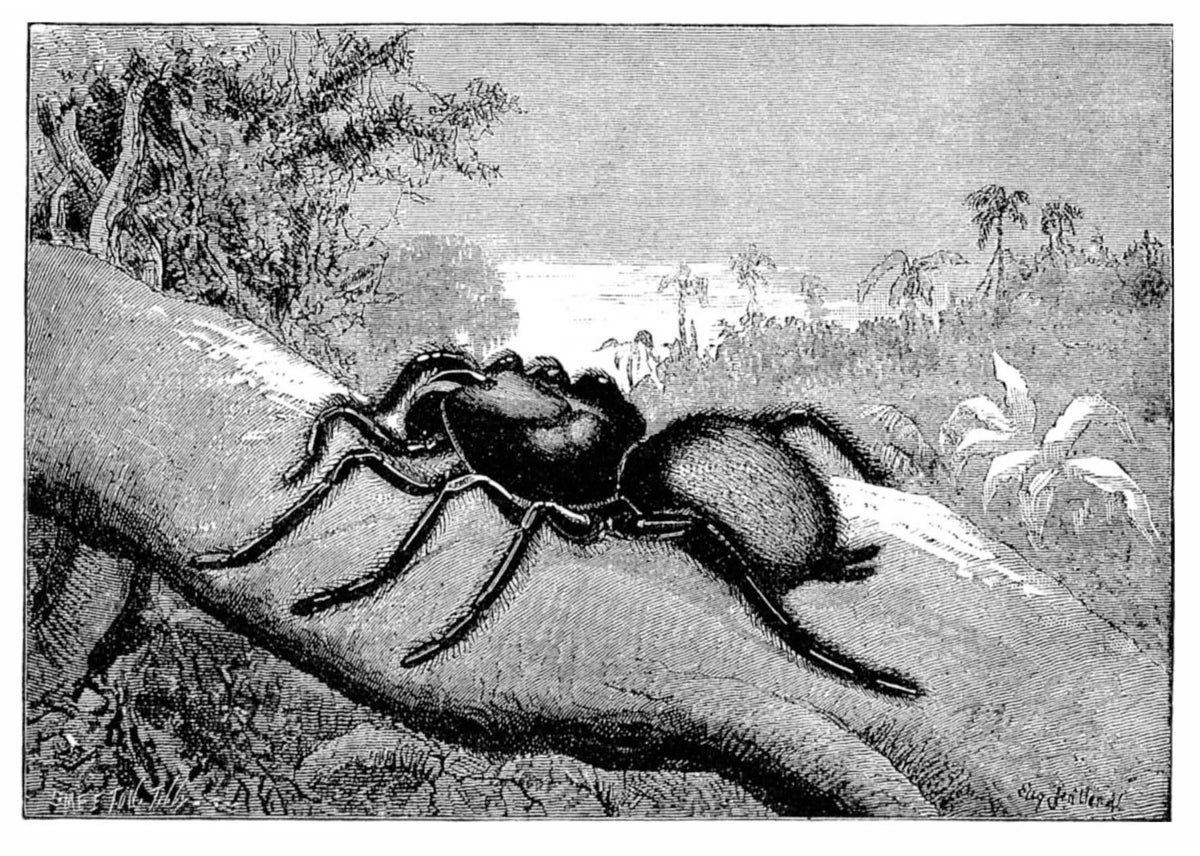
Wind back another fifty years to 1876, and the spirit is the same - if the subject matter is rather more eight-legged. A Scientific American article published on 24 June 1876 documented the Mygale trapdoor spider of Corsica with meticulous precision: the vaulted tubes it digs in clay banks, the tightly woven white silk cocoon in which it carries its eggs, the eight eyes, the mandibles armed with sharp teeth, and - the detail that catches every reader - retractile claws resembling those of a cat. A spider with claws like a cat.
The naturalists of the 19th century wrote as though every creature deserved the full weight of careful attention. Because every creature did. This kind of description drove real science forward: the same exacting attention to spider anatomy that characterised the Mygale article helped inform later work on arachnid biomechanics, silk mechanics, and the evolutionary pressures shaping ambush predators. Without such records, comparative biology would be guessing. Description is not a lesser form of science. It is science's foundation.
The Long Game Knowledge Plays
Each of these moments - 1876, 1926, 1976 - answers the same question the same way. Science does not advance through isolated genius. It advances through accumulation: observation stacked on observation, paper built on paper, generation teaching generation.
The electron-hole liquid that flickered into existence and vanished inside a crystal in 1976 still informs semiconductor physics and optoelectronics research today. The seismic evidence gathered in 1926 still underpins how geophysicists model Earth's deep interior and the dynamics of the inner core boundary. The Mygale spider of 1876 - with its cat-like claws and silk cocoons - still stands as an example of the painstaking natural history records on which evolutionary biology depends.
That illustration from 150 years ago - a spider in cross-section, eggs cradled in silk, claws raised - is an image of a scientist doing the quiet, irreplaceable work of noticing. The electron-hole liquid does something similar: it exists only because a researcher chose to look carefully at what happened inside a cold crystal struck by light. Three centuries apart, three disciplines, one instinct. What endures is the work. What endures is the looking.
This article was researched and written with AI assistance, then reviewed for accuracy and quality. DRS Web Development uses AI tools to help produce content faster while maintaining editorial standards.