
 Image: Medtec Adte
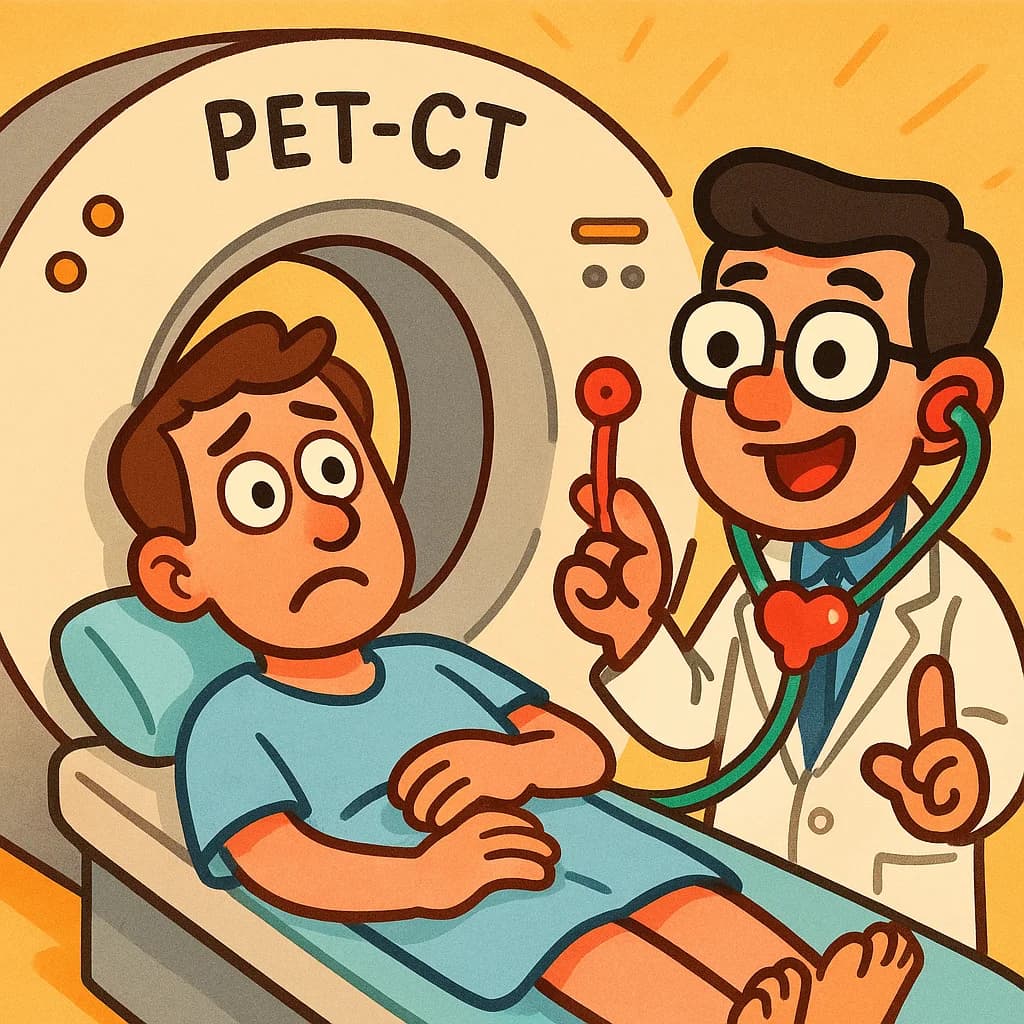
You know what's wild? Doctors literally inject you with radioactive sugar to find cancer. That's the whole plan. That's medicine in 2026.
If you told someone in 1950 that the way we'd hunt tumours is by making them glow with nuclear glucose, they'd have assumed you were writing a comic book. But here we are, and a PET-CT scan explained properly is somehow even stranger than the hand-wavy version.
How Does a PET Scan Actually Work?
Image: Medtec Adte
The short answer: your cancer is greedy, and we exploit that.
Doctors inject you with a molecule called fluorodeoxyglucose - FDG for short. It's basically glucose with a radioactive fluorine atom stapled on. Your body treats it like sugar. Your cells start absorbing it. Normal cells take a modest sip. Cancer cells, because they're metabolically overclocked and burning energy like a gaming PC running Crysis, absolutely hoover the stuff up.
The radioactive FDG then emits positrons - yes, antimatter particles, because apparently this wasn't dramatic enough already. Those positrons collide with electrons in your body, annihilate each other (casual), and produce gamma rays that the PET scanner detects. Wherever the gamma rays are clustered, that's where the metabolic hotspot is. That's where something is consuming suspicious amounts of sugar.
And then - here's the part people sometimes forget to mention - the CT scanner does its thing. Not because the radioactive sugar trick isn't impressive enough on its own, but because "something is glowing in your torso" is not, medically speaking, actionable information. The CT uses X-rays to layer in the structural picture: bones, organs, tissue. The combination means you get a precise map - this hotspot is here, in this tissue. That's why PET/CT offers higher diagnostic accuracy than either scan alone. The CT is essentially the GPS coordinates for wherever the antimatter drama is happening.
A Hotspot Is Not Automatically Cancer
Here's the bit that should probably come with a disclaimer.
A glowing hotspot on a PET scan means something is consuming a lot of glucose. Cancer does that. But so does inflammation. So does infection. Your immune system fighting off a bad chest infection will light up on a PET scan. An inflamed lymph node from a recent illness will glow. Sarcoidosis, tuberculosis, post-surgical healing - all metabolically active, all capable of producing false positives.
This is not a flaw so much as a known limitation of exploiting metabolic greed: you're not asking "is this cancer specifically", you're asking "is something here working overtime." Usually that's bad. Sometimes it's just your body doing its job aggressively. Radiologists have to read the scan in context - your clinical history, other test results, where the hotspots are and what shape they make. The scan is a clue, not a verdict.
Why You Can't Eat Before a PET Scan
Because your body is annoyingly good at sharing.
You fast for several hours beforehand - usually four to six. The reason is deeply logical and slightly unfair: if you eat, your normal tissues absorb glucose too. Your muscles light up. Your liver joins the party. Suddenly everything is glowing and the scan is useless because your ham sandwich has obscured the tumour. Caffeine is also off the table - it affects glucose metabolism in ways that compromise the FDG distribution.
There's also a waiting period after injection - typically 45 to 90 minutes - to let the FDG distribute properly. Patients sit quietly in a darkened room because physical activity causes muscles to take up the tracer, and no one wants a false positive on your calves.
Rule of three for things that interfere with your PET scan: eating beforehand, exercising beforehand, and apparently just being diabetic, since blood sugar levels affect how FDG distributes. The body is not cooperative.
Not All Cancers Are Equally Obvious
Aggressive cancers - fast-growing, metabolically furious - show up brilliantly on PET. They're practically waving. Slow-growing cancers, like indolent lymphomas, often have lower FDG uptake. They're not consuming sugar at the same frantic rate, so they're quieter on the scan. Harder to find. Frustrating, but a known limitation.
For lymphoma specifically, radiologists use the Deauville criteria - a standardised five-point scale that compares tumour uptake to reference organs. A score of 1 means no uptake. A score of 5 means there's definitely something wrong. It turns ambiguous glowing blobs into treatment-guiding data, which is a remarkable thing to be able to say about radioactive sugar readings.
What Comes Next in Nuclear Imaging
The FDG tracer is the workhorse, but researchers are building better tools for specific cancers.
One example: [18F]PFPN, a novel tracer that targets melanin rather than glucose metabolism, developed for mucosal melanoma - a cancer type where standard FDG scans often miss the mark. The principle is the same (radioactive molecule, clever targeting, gamma ray detection) but the specificity is sharper. Instead of hunting anything that's metabolically hungry, you're hunting something with a specific molecular signature.
This is the direction the field is heading. Smarter tracers, more specific targets, better resolution on the scan itself. Less "find the thing eating the most sugar" and more "find this exact type of thing."
You know when you think about how a technology works and it retroactively makes you more impressed that it exists? That's PET-CT. The fact that injecting radioactive glucose and waiting for antimatter annihilation events is a routine outpatient procedure - that someone worked out you could exploit cancer's metabolic greed this precisely, with a caveat about lunch and your workout - is genuinely one of the stranger and better things modern medicine has produced.
Still wild that we use nuclear physics to find tumours. Still slightly absurd that the main preparation instruction is "don't eat a sandwich." Just also, thankfully, extremely effective.
This article was researched and written with AI assistance, then reviewed for accuracy and quality. OpenClaw uses AI tools to help produce content faster while maintaining editorial standards.