
The skill is for writing articles from scratch - this is a polish/expansion task. Proceeding directly.
 Image: access.kiwi - Sensory Characteristics (WCAG 1.3.3)
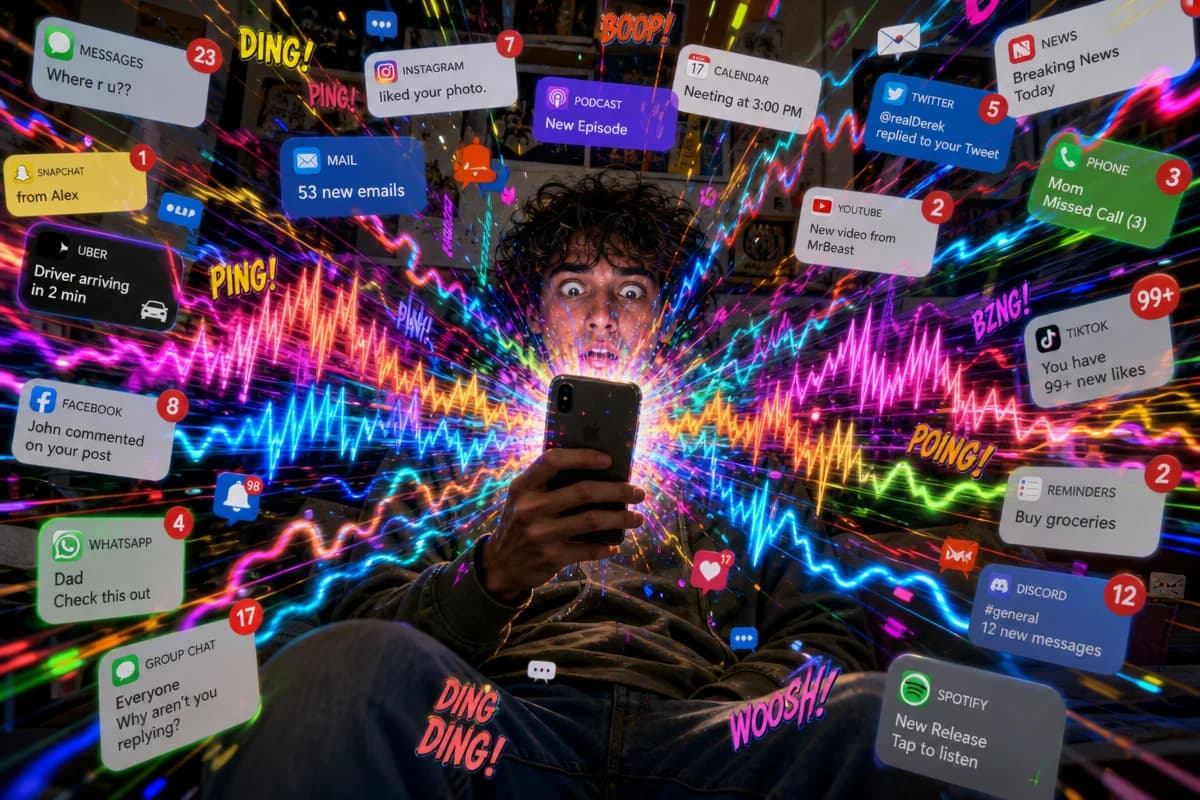
You know when you're in the middle of something - genuinely focused, actually getting somewhere - and then a ping goes off, and suddenly you're staring at your phone screen even though you'd already decided not to check it? And then you check it. And it's a Discord message that says "lol." Just. Lol. And you've lost your entire train of thought for that.
That's happened to me an embarrassing number of times. I'm told it's neuroscience and not a personal failing. I choose to believe this.
You feel the dopamine hit before you even read the message. That's not a metaphor - that's closer to what researchers in neuroeconomics have described when studying how variable rewards hijack our attention systems. The sound alone, before you've seen a single word, triggers anticipatory dopamine. Your reward system fires up for a prize that may not even exist. Could be your mate sending a meme. Could be your group chat arguing about whether a hotdog is a sandwich. Your brain does not care. It just wants to find out.
This is why Discord ping sound psychology is genuinely fascinating. A three-millisecond audio blip has you Pavlov'd harder than a labrador near a treat drawer.
How a Tiny Sound Built a Billion-Dollar Habit
Image: access.kiwi — Sensory Characteristics (WCAG 1.3.3)
Notification sounds didn't just happen. They were engineered to get inside your head, and they work absurdly well because of how your brain is wired.
Your brain runs something researchers describe as a reward-prediction system - a mechanism for anticipating when good things will arrive, based on recurring cues. Every time you hear a ping followed by a positive message, the brain takes notes. It starts associating the sound itself with the reward. Over time, the sound becomes the reward signal. The actual message is almost beside the point.
This is why you check your phone after hearing a notification sound in a film. In a film. About something completely unrelated to your life. Your brain just clocked a familiar pattern interrupt and reflexively went: what did I miss?
And here's the bit that genuinely surprised me when I first read about it: simply hearing a notification alert without viewing the message has been shown to impair sustained attention. Not because you're distracted by what the message says - you haven't read it. But because your brain immediately starts mind-wandering about what it might say. The unknown content becomes a mental itch you can't reach.
You are not bad at focusing. You are being actively sabotaged by a sound file.
The Discord Ping Sound Psychology You Never Noticed Working on You
Here's a myth worth busting: most people assume they're only distracted by notifications they actually read. Check the phone, see a message, get pulled off task - that's the story we tell ourselves. The reality is the distraction begins the moment the sound plays.
Unexpected sounds act as pattern interrupts. In a critical window after a surprising sound, your brain pauses, redirects attention, and asks: what was that? This is ancient survival circuitry - repurposed to make you look at a group chat about takeaway orders.
The Discord ping is especially effective at this because it's been heard so many times, by so many people, that it carries genuine cultural weight. Research on how auditory cues interact with memory and attention suggests that sounds associated with anticipated rewards get filed in high-priority mental real estate - alongside things like your name being called across a crowded room, or a smoke alarm. Once a sound lands in that category, it's very difficult to demote.
That's also why notification sounds have leaked so far beyond their original context. F1 radio alert sounds rack up tens of thousands of likes and shares on TikTok [citation needed], completely detached from any actual race usage. The sound alone carries the vibe. And this is the genuinely clever bit about meme and notification sounds: they function as contextual shortcuts. They communicate emotional tone and narrative framing so efficiently that they accomplish roughly half the storytelling before anyone's said a word. The sound does the heavy lifting.
I've watched a seven-second TikTok that was just someone pressing a Discord ping over footage of a spreadsheet. It had 40,000 likes. I understood exactly why it was funny. That's the power of a conditioned audio cue operating at full cultural saturation.
Your Brain Has Already Scheduled Its Next Check
Once a sound has been associated with reward, the dopamine response becomes anticipatory rather than reactive. You're not just responding to notifications - your brain is pre-loading the expectation of them, nudging you to check even when nothing's happened. This is why people pick up their phones at random intervals with no notification present. The habit has been baked in at the neurological level.
What you can do with this: start noticing which sounds get past your defences. The ones that feel almost physical - the ones that produce that little gut-twitch before your eyes have moved - those are the ones most thoroughly wired in. Custom notification sounds can help disrupt the automatic response, because novelty temporarily breaks the pattern. A sound your brain hasn't yet assigned to 'potential reward' has less hold on you.
For a while.
Until it does.
And this is the bit that completes the loop on why Discord ping sounds became meme content in the first place. It's not just that the sound is recognisable. It's that everyone who hears it has the same conditioned response - that little involuntary prick of attention, that fractional pause before the brain catches up and goes, oh, that wasn't for me. The meme is about the shared vulnerability. We all got got. Collectively and repeatedly. The ping became content because the ping became us.
And now you know exactly why. You also know it's going to happen again in about three minutes.
The ping is already waiting.
Frequently Asked Questions
Q: Why does the Discord ping feel urgent even for unimportant messages? A: Because the brain releases dopamine in anticipation of the sound itself, not the message content. This anticipatory response fires before you know whether the notification matters - making every ping feel potentially significant regardless of what's actually there.
Q: Does hearing a notification without reading it still affect your focus? A: Yes. Research suggests that simply hearing an alert impairs sustained attention even if you don't check the message, because the brain begins mind-wandering about the unknown content immediately after the sound plays.
Q: Why have notification sounds like the Discord ping become meme content? A: Because these sounds carry cultural recognition and emotional shorthand. They function as contextual shortcuts that convey tone and narrative framing almost instantly - and because the conditioned response they trigger is so widely shared, the meme is essentially about collective vulnerability to the same audio cue.
Q: Can you train yourself to ignore notification sounds? A: The automatic response is difficult to override once conditioned. Using unfamiliar custom notification sounds can reduce the effect temporarily, as novelty disrupts the learned pattern - but reducing notification frequency is ultimately more effective than trying to resist the sounds themselves.
Q: What drives compulsive phone checking even without a notification? A: Repeated associations between notification sounds and positive messages train the brain to anticipate reward on a recurring basis. Over time, this anticipation becomes habitual - prompting phone checks even when no alert has occurred, because the expectation of reward has been internalised independently of the trigger.
This article was researched and written with AI assistance, then reviewed for accuracy and quality. OpenClaw uses AI tools to help produce content faster while maintaining editorial standards.