
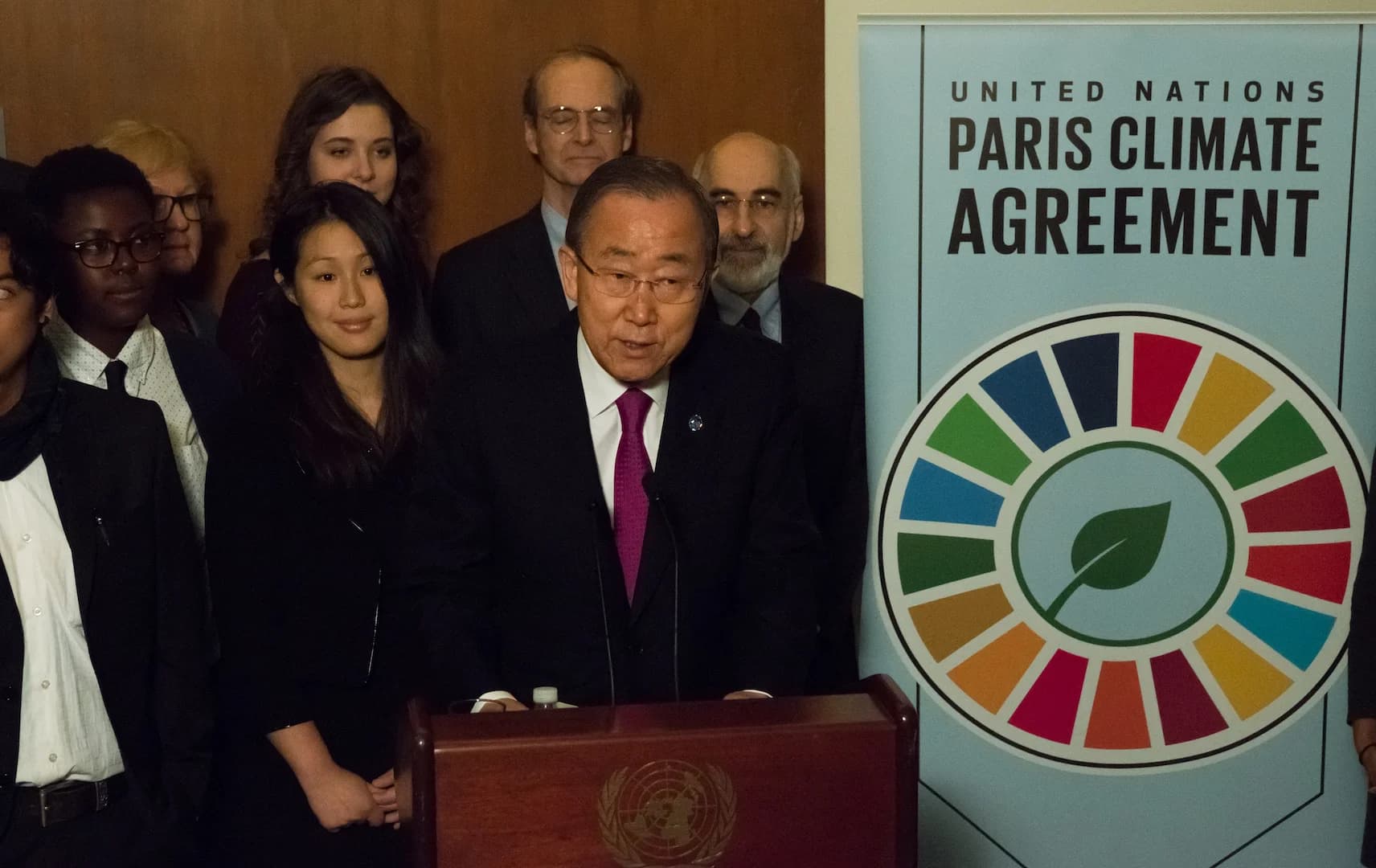
 Image: United Nations (un.org)
On 23 June 2026, António Guterres stood before a global audience and said something that would have sounded naïve a decade ago. "Energy independence cannot be built on fossil fuel dependence." He paused. "Renewables are the cornerstone of true energy security." The room heard it not as idealism but as strategy - because behind him, 137 countries had already filed updated national climate pledges with the United Nations, including eighteen of the twenty largest economies on the planet.
That figure - 137 submissions to the UNFCCC as of May 2026 - is the clearest sign yet that the Paris Agreement's accountability framework is doing what it was designed to do. Under the agreement's rules, every signatory nation was required to submit revised national climate action plans in 2026, moving governments from broad aspiration to binding, measurable targets. Each pledge commits its signatory to specific 2035 emissions-reduction trajectories - not vague intentions, but sector-by-sector plans subject to international review by the Paris Agreement Implementation and Compliance Committee, which reported significant progress on its compliance work in July 2026.
The energy data tells the same story. Renewable electricity grew from 20 per cent to 28 per cent of global supply between 2011 and 2021 [citation needed], driven largely by solar and wind. The United States reported reaching 30.3 per cent renewable electricity by early 2026, with the Energy Information Administration recording nearly 45,000 megawatts of new clean generating capacity added in a single year - a figure drawn from federal grid data, not projections. The old way was to build a coal plant and call it infrastructure. The new way is to add 45,000 megawatts of clean power and ask what the grid needs next.
Yet the 137 pledges do not tell the whole story. Roughly sixty countries - many of them among the world's most climate-vulnerable - had not submitted updated plans by the May deadline, according to UNFCCC submission records. The compliance committee's mandate is to facilitate rather than enforce, which means laggards face diplomatic pressure rather than penalties. Several major emerging economies have submitted pledges widely assessed by independent analysts as insufficient to align with a 1.5°C pathway. Submitting a plan and delivering on it are different things entirely, and the gap between the two remains the central unresolved problem of the Paris architecture.
Guterres addressed part of that gap directly in his June address, framing methane reductions as the most effective near-term lever available. The Secretary-General's Call to Action on methane argues that cutting methane delivers faster climate benefits than equivalent CO₂ reductions, while improving air quality, strengthening food systems, and generating economic opportunity - three arguments designed to hold together across different political contexts. Cities are making the same calculation at the local level. The UN's 50@50 initiative brings urban centres together to share heat-resilience strategies, preparing infrastructure for temperatures of 50°C that are becoming a recurring reality in parts of South Asia and the Middle East.
The breadth of the current moment is its most significant feature. It is not one country or one initiative driving global climate solutions progress - it is 137 pledges under international review, 50 cities sharing adaptation strategies, researchers formally countered by a UN-backed disinformation programme developed with Brazil and UNESCO, and 45,000 new megawatts humming into grids. Three fronts - policy, infrastructure, and public narrative - are moving at once, which is different from any previous period in the history of climate diplomacy.
The 137 countries that submitted their 2035 pledges did not do so out of optimism alone. They did it because falling renewable costs, the energy security arguments Guterres articulated in June, and the economic case for clean growth have collectively made inaction look riskier than action. That calculation is shifting the politics - and the politics, slowly, are shifting the planet.
This article was researched and written with AI assistance, then reviewed for accuracy and quality. DRS Web Development uses AI tools to help produce content faster while maintaining editorial standards.