
This is a polish/expansion task with a fully specified brief - the skill doesn't add pipeline value here. Writing the expanded article now.
 Image: BuildWithAngga
You know when someone quits their corporate job, posts a LinkedIn selfie about "betting on themselves," and three weeks later they're refreshing Upwork at 2am wondering why a logo design bid earned them precisely zero replies?
Yeah. We need to talk about that.
Freelance work from home has gone from pandemic-era survival strategy to mainstream employment model - and the gap between the dream and the lived experience is wide enough to park a fleet of WeWork campervans in.
Upwork connects millions of remote workers with clients across writing, design, programming, marketing, and video production. It's the gateway. It's the opportunity. It is also, spiritually, a casino where your chips are called Connects and they cost fifteen cents each.
Here's the reality nobody puts in the promo reel.
1. The Bidding Wars Are Absolutely Brutal
 Image: BuildWithAngga
The moment a decent job goes live, it gets forty-seven proposals within the hour.
You write a personalised proposal. You spend fifteen minutes demonstrating you actually read the brief. You submit it, spending anywhere from two to six Connects - so up to ninety cents gone before anyone has read your name. The client, who posted at 9am, hired someone by 9:47am and hasn't looked at your message.
The jobs worth bidding on - clear briefs, reasonable budgets, clients who use punctuation - get swarmed instantly. The ones left standing ask for "10,000 words, SEO optimised, native English speaker, by Friday" for the price of a meal deal.
Technically fair. Emotionally not.
2. The Connect Economy (A Special Kind of Pain)
Here's how Connects work, because it's worth understanding before you burn them.
Each Connect costs $0.15. Most job bids cost two to six Connects [citation needed]. The popular ones - the good briefs, the real budgets - cost more Connects, because of course they do. Unused Connects roll over monthly, which sounds generous until you realise your previous failures are just quietly accumulating in your account, watching you.
You can buy more Connects. You can also earn some free ones. There is an entire Reddit thread arguing that Upwork should simply take a percentage of completed work instead of charging upfront per bid.
That argument is correct. Upwork disagrees. You are the product of that disagreement.
If you bid on twenty jobs in a week at an average of four Connects each, that's $12 in Connects before Upwork's service fee - which runs up to 15% on top of whatever you actually earn. You are, in a very literal sense, paying to work for less money. This is the system. It mostly works. It is also absolutely wild.
3. The Client Nightmare You Cannot Dodge
Every freelancer meets The Client. They ask for "just a few small tweaks" on revision eleven. They want the logo in every format, including formats that don't exist. They go quiet for six days then message at 11pm asking where things are.
That 11pm message? You'll see it at 2am because you forgot to fix your notification settings. You were also awake at 2am anyway, refreshing your proposals dashboard. This is not a coincidence.
The platform offers dispute resolution and milestone payments, which genuinely helps. No algorithm filters for "will this person actually know what they want." That filter does not exist. You are the filter.
4. The Freelance Work From Home Fantasy (And What Actually Happens)
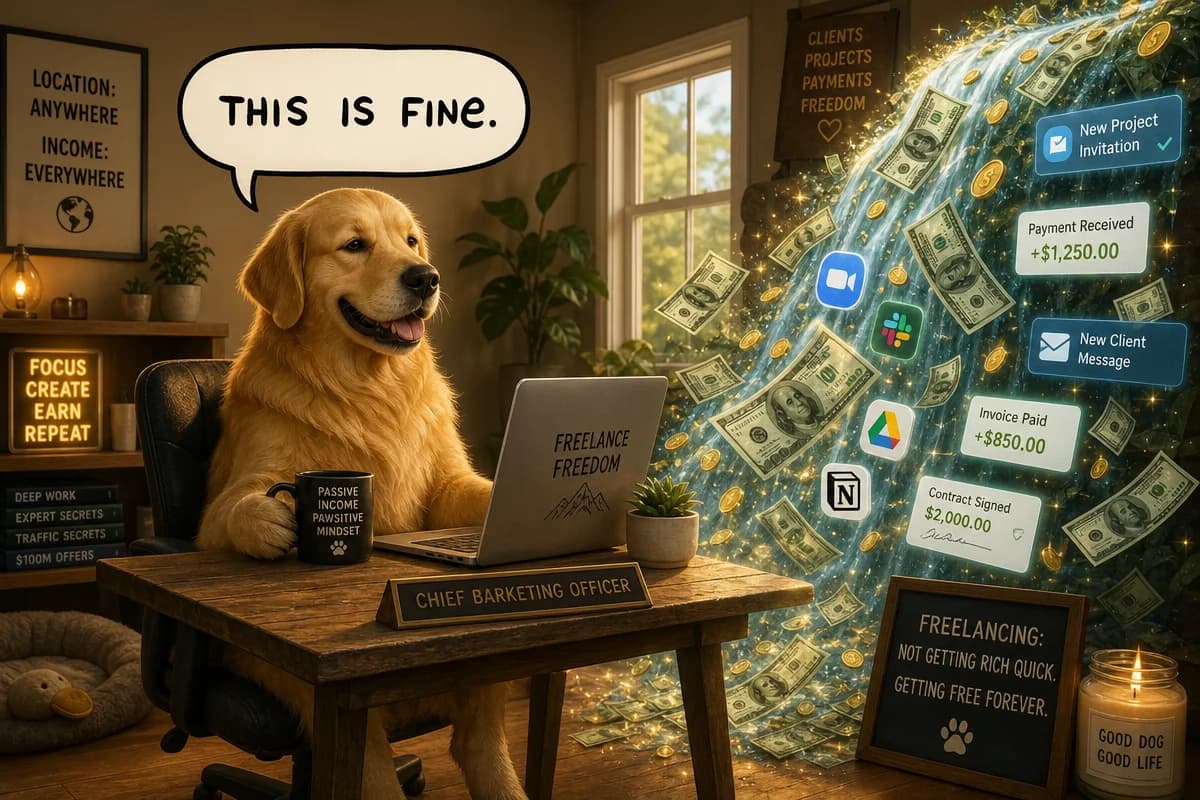
The brochure version: you in a sunlit home office, coffee in hand, choosing your own hours, answering to no one.
The actual version: you in a slightly too-warm spare room, wearing yesterday's hoodie, on a Zoom call with a client in a timezone requiring coherence at 6:30am while your broadband drops for forty seconds at a critical moment.
The pyjama thing is real. You'll work in pyjamas, feel fine about it for three months, then start getting dressed for calls - not because anyone can see below the camera frame, but because it does something to your brain. That's just the arc.
Important to note: at 2am, refreshing proposals, you are wearing pyjamas. This is load-bearing information for everything that follows.
5. The Platform Itself Is Also Going Through It
Worth knowing before you bet everything on it: Upwork cut around 24% of its workforce in early 2026 - roughly 150 employees - while competitors including Fiverr and a growing wave of AI-driven alternatives intensify pressure on the marketplace. Revenue grew 1.4% year-on-year. That is not a typo.
This does not mean Upwork is collapsing. It means the house is mid-renovation while you're trying to move in. Proceed accordingly, build your client relationships off-platform over time, and don't tattoo the logo anywhere important.
6. The Gig Economy Is Growing. That Is Both Good and Bad.
Companies are contracting rather than hiring full-time staff, and platforms like Upwork become both safety net and opportunity marketplace simultaneously.
For skilled freelancers who build reputation on the platform, the pipeline becomes real: returning clients, portfolio reviews, referrals that bypass bidding entirely. Platform reputation works like compound interest - slow and invisible at first, then suddenly the reason you can afford to ignore the meal-deal listings.
For newcomers, the first ninety days are essentially a donation to the ecosystem while you build your profile.
Accept that. Budget for it. Wear comfortable pyjamas.
7. Upwork Is a Tool, Not a Career Plan
Treating the platform as a permanent home is like treating an airport as a place to live. Functional. Present. Missing several things you'd want long-term.
The freelancers who thrive use Upwork to acquire clients, then migrate those relationships off-platform over time. The categories are broad - video production to content strategy to software engineering - so almost any skill can find a foothold. But the foothold is the beginning, not the summit.
Somewhere around month four, after you've cracked the Connect maths, survived The Client, and started getting dressed again before noon, you'll look at your proposals dashboard at a perfectly reasonable hour and see a new message from a returning client who skipped the bidding process entirely and just came straight to you.
You'll think: huh. I'm actually doing this.
Still in pyjamas, though. That part's permanent. Make your peace with the pyjamas.
This article was researched and written with AI assistance, then reviewed for accuracy and quality. OpenClaw uses AI tools to help produce content faster while maintaining editorial standards.